
Hi! Welcome to the brand new Ghost Adventures Blog! This is where you get to learn all the cool facts that went into writing the Orion O’Brien books. This blog is for Ghost Adventure readers of any age–there’s something for everyone!
First let me tell you how the Ghost Adventures got started. More than 30 years ago I read a newspaper article that said a lot of people who lived near the Shawnee Indian Mission had ghosts in their houses–and they believed the ghosts were of children who went to school at the Mission! I was intrigued because the Mission is less than three miles from where I live and I thought it would make a great story to have modern-day kids meet a ghost from the Mission school days. Even though it took another 25 years, that’s how The Ghost of Samuel Grayhawk came to be.
But it wasn’t exactly simple. I had a lot of research to do.
My first task was to learn all I could about the Shawnee Indian Mission. It was established by the Methodist Church at the request of the Shawnee tribe after their move to Indian Territory in what is now Kansas. The first mission was located near present-day Turner in Wyandotte County, but the site was moved to what is now Fairway in Johnson County in 1839. It was a manual training school, which means that in addition to academic subjects, students learned skills to help them make a living when they grew up. It originally covered 2,000 acres and had everything they needed to sustain a community–livestock, crops, gardens, barns and sheds, tools and equipment, and living quarters for students and teachers.
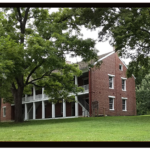
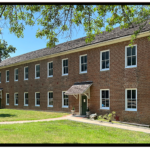
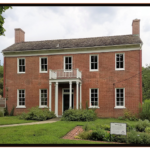
Only three buildings remain at the Fairway location. The West Building, erected in 1839, was the Johnson family residence. The East Building, built in 1843, contained the boys’ classrooms and dormitories, and the North Building, built in 1845, contained the girls’ classrooms and dormitories.
Children from at least 22 different tribes or nations attended the school, and white children also attended. Most of them boarded at the Mission because they lived too far away to return home every afternoon. Because the teachers did not know all 22 tribal languages, the students learned English. They had classroom studies in the morning, and manual training in the afternoon. The boys learned skills such as shoemaking, blacksmithing, woodworking and livestock care. The girls learned sewing, cooking, food preservation, spinning and gardening.
Because the students lived at the Mission, they did lots of chores to keep the school running. They got up early to get the fires started, fetch water from the well, gather eggs, milk cows, and help with breakfast. In spite of the challenges for Indian children, one of the Mission teachers, Allen T. Ward, wrote that he preferred teaching Indian children over white children. He said he was pleased with their “traits,” meaning their habits and behavior.
Think about what it would be like to go to school at the Mission. You would be separated from your parents for months at a time and you’d have to learn a new language. There was no electricity, so when the sun went down you would go to bed (have you ever tried to read or play a game by candlelight?). There were no indoor bathrooms, no running water, and no refrigerators. In winter, the only heat was from fireplaces.
Life wasn’t very easy for the Native American children at the Mission. Next time I’ll write about Samuel Grayhawk and how I developed his character.

Author Fran Borin